

Chat with Stephen Elkind, Product Counsel @ Google
Updated: Sep 15, 2025
A candid conversation with a Google attorney counseling the teams for Gmail, Google Meet, and Gemini in Workspace. Stephen chats about timing your jump, using referrals wisely, and surviving your first six months in‑house.
TL;DR — Stephen’s Playbook
Target window: Aim to move ~3–6 years out of law school. Too early and you’re under-baked; too late and you’re competing with people who already have years in‑house.
Apply fast, at the source: Set alerts on company career sites and apply within hours of a posting.
Engineer a nexus: Shape your resume and matters so they touch the company/role you want (e.g., privacy for product counsel; secondments to target clients).
Referrals > cold apps: Warm intros from trusted insiders meaningfully de‑risk a hire. Build a reputation people will vouch for.
Expect a 6‑month ramp: You’re client‑facing day one. Learn the org’s language, find mentors, and be patient with yourself.
Meet Stephen
When we reconnected, Stephen’s excitement about new responsibilities at Google was obvious.
“I’m now the lawyer for Gmail!…Everyone uses Gmail. That’s insane.”
But Stephen’s route wasn’t linear. He clerked on the Federal Circuit (heavy on patents), spent years in Big Law and at a boutique, and then moved in‑house — first to Meta, now to Google.
The Moment He Knew Big Law Wasn’t It
Like many ambitious law firm associates, Stephen’s initial goal was to become partner at a law firm. But the grueling hours and his own flagging interest in the work prompted him to find another solution.
He explored a smaller boutique — one with more transparency and a different mix of work — as a potential path. But partner hours (30%-40% more than associates) showed him this path was also not feasible.
“It was not a sacrifice I was willing to make for the payout.”
Why In‑House? (And Why Product Counsel?)
Stephen loved the nerdy parts of patent litigation: working with experts, senior engineers, and pulling apart how products actually work.
“[As a product counsel] you’re embedded with engineers and PMs, helping understand the product to come up with the legal risk analysis.”
Lifestyle mattered too:
“I wanted to stop billing hours. I wanted to have weekends, evenings. You have a lot more control over your time in‑house.”
Timing Your Jump: Why \~3–6 Years
“When you’re in‑house, you are client‑facing immediately…You need to understand what drives the business, how your risk analysis should inform decisions, and how to convey.”
Law firms can teach judgment and hierarchy, but the soft skills — reading the room, calibrating risk, advising succinctly — become the differentiator. Too junior and you’ve never had to do it. Too senior and you’re up against in‑house veterans at your level.
Stephen’s advice. If you’re still at a firm:
Pursue secondments to target companies. It’s an extended mutual interview and often a pipeline to a role.
Get onto your firm’s matters for the companies you want.
Curate your resume for the role, truthfully but intentionally. Lead with experiences that mirror the job.
How Stephen Reframed His Law Firm Experience:
Found opportunities to work with experts and engineers on patent matters: Stephen spoke often with senior engineers at client companies to understand how products worked.
Focused on building expert reports: These are factual, technical reports tied to product functionality (rather than pure legal theory).
Sought out privacy law touchpoints: Stephen used a single discovery motion that involved GDPR as a story for every in-house role interview, to show he had privacy experience.
Tailored his resume: Instead of “managed discovery” as your first bullet, put instead “coordinated experts and engineers”. Note: this work covered only ~10% of his law firm workload, but it aligned most with a product counsel role.
Prepare for the interview: map your real experiences to the required qualifications and have 2–4 concrete examples ready for each.
Applications: Be First, Be Referred, Be Reputable
Stephen’s advice is refreshingly tactical.
Visit company websites often, and apply quickly.
“Go to the company website. Set up alerts. Apply quickly. You don’t want to apply when four other candidates are already at the final stage.”
He’s honest about rejection:
“I applied to a Google role and got rejected in 24 hours! It’s ok, you only need to say yes.”
And he’s blunt about the force multiplier:
“Never apply cold if you can help it. Referrals de‑risk a hire…Every hire is a risk. Trusted referrals help managers take it.”
And above all else: guard your reputation.
“We had a candidate I used to work with. People asked if I’d refer them. I had to be honest and say not from my experience — and that was the end of that.”
Your First 6 Months In‑House
Expect to feel behind. Learn the org’s language and cadences. Find mentors — formally or informally — and give yourself time:
“At Meta the wisdom was a six‑month ramp up minimum. I remember asking one good question around month two or three and my manager said, ‘That was a good question.’ It takes time.”
The same reset happened when he moved from Meta to Google:
“New systems, people, processes…Learning how to contribute takes time. Be patient — and aggressively seek ways to add value.”
Concrete Moves If You’re Aiming for Product Counsel
Make a target list (5–10 companies). Set career‑site alerts.
Audit job reqs and align your bullets to the required skills.
Get proximate: secondments, client teams that serve your target companies, adjacent matters.
Build two referral paths (inside counsel and ex‑firm alums now in‑house).
Practice being concise and calibrated — risk triage; don’t over-lawyer
Expect a 6‑month ramp, and line up mentors before day one.
“It’s the soft stuff that distinguishes candidates.”
A Note on Paying It Forward
“I wouldn’t be here except for a handful of folks who helped me get in‑house. I love trying to demystify this stuff and pay it forward, so I make it a point to always try to be helpful. These jobs are gate‑kept. They’re hard to get. We need more people willing to pay it forward.”
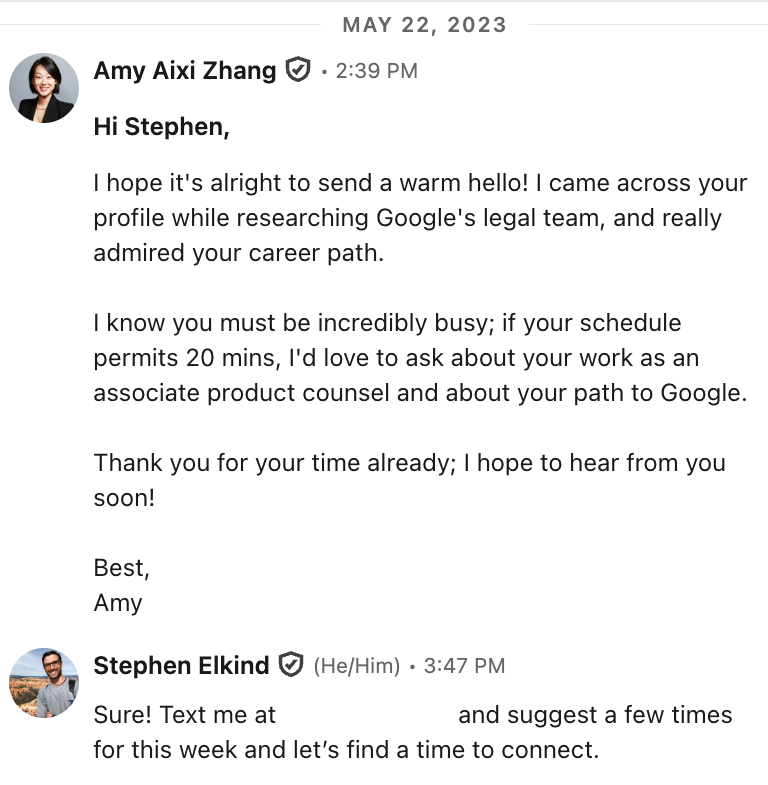
I myself owe Stephen thanks for the dream job I have today. Stephen (1) read a random, unexceptional, cold LinkedIn message (see below) (2) decided to chat with me about his work and role, and (3) nudged the Deputy General Counsel of Ramp to review my resume.
Stephen’s leadership and ethos also partly inspired this blog.
If this was helpful, share it with the junior associate who keeps asking you how to break in‑house. And if you’re hiring, maybe be the trusted referral for someone who’s ready.
Have thoughts or questions for Stephen? Send them my way — I’ll try to include a short follow‑up. Subscribe for future interviews!
Comments